Regional Indian Wedding Jewelry: How Traditions Shape Bridal Designs

No two Indian weddings look the same. A bride in Punjab and a bride in Kerala may both wear gold, but the shapes, the weights, and the meanings are quite different. Regional Indian wedding jewelry reflects local history, climate, and belief. This guide walks through some of those differences and shows why each region’s choices make sense.
Regional Bridal Jewelry Traditions
Regional bridal jewelry traditions began with local resources and local customs. Areas with strong trade in pearls developed pearl-heavy sets. Places with royal courts favored large gold work with stones. Hill and tribal regions often used silver.
Religion and community shape the rules too. A Hindu bride, a Muslim bride, a Sikh bride, and a Christian bride may each wear different pieces. Some are required by custom. Others are chosen for family reasons.
Even inside one state, styles can change from town to town. Families often keep their own patterns, which they pass down through each generation.
Traditional Indian Wedding Ornaments
Traditional Indian wedding ornaments follow a few common groups. Necklaces and chokers sit at the neck. Earrings and nose rings frame the face. Bangles and armlets decorate the arms. Waist belts, anklets, and toe rings finish the look.
Some ornaments are tied to marriage itself. The mangalsutra, a black bead necklace on a gold chain, is worn by married women in many Hindu communities. In Bengal, the shakha and pola, white conch shell and red coral bangles, mark a married woman. In Punjab, the chooda, a set of red and ivory-colored bangles, is a central part of the wedding.
These items carry meaning that goes beyond looks. Families often feel a deep link to them.
Cultural Differences in Bridal Jewelry
Cultural differences in bridal jewelry show up in size, color, and material. In the north, brides often wear heavy gold with Kundan or polki. In the south, temple jewelry takes the lead, with gods and goddesses carved into the gold. In the east, shell, coral, and fine gold work are common. In the west, pearls and bold nose rings are popular.
Color also shifts. Red and gold dominate many northern weddings. White and gold stand out in Kerala, where brides often wear a kasavu saree, which has a plain cream body and a gold border. Green and gold are loved in several regions.
Climate has an effect. Hot, humid places favor lighter pieces. Cooler places can carry heavier layers. Makers adapted to these conditions over time.
Indian Bridal Accessories History
Indian bridal accessories history connects to the old idea of the sixteen adornments, called solah shringar. This idea covers jewelry, flowers, henna, and other items that prepare a bride. It appears in various forms across the country.
Royal courts then added their own touches. Rulers wanted grand sets, and craft workshops grew around those orders. Their methods later spread to wealthy families and then to a broader public.
Gold has long served as a form of security as well. A bride’s jewelry was her own property. It gave her support if she needed it. This practical side explains why many families still invest heavily in bridal gold.
Many weddings today still follow this pattern. A set of Indian bridal jewelry may be built from family gold, newly made pieces, and a few gifts from relatives, each with its own reason for being there.
Traditional Earring Styles in India
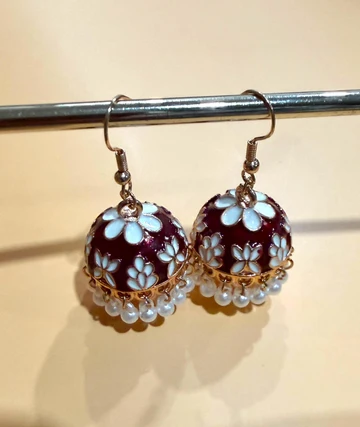
Traditional earring styles in India differ widely. The jhumka, with its dome and hanging drop, is the best-known. The chandbali, shaped like a crescent, is linked with Mughal taste. The kundal is an old form found in ancient texts. In Maharashtra, the bugadi sits along the upper ear, often with pearls. In Kashmir, the dejhoor is a long gold earring worn by married Hindu women.
South Indian jhumkas often use bold gold domes with rubies or pearls. Northern versions may add Kundan stones and enamel. Gujarat and Rajasthan are known for silver and oxidized pairs.
A pair of Indian earrings jhumka suits many bridal looks because its shape is easy to match. It works with a plain neckline or a heavy necklace, and each region has its own take on it.
Heritage Jewelry Designs
Heritage jewelry designs reflect long-held patterns. Flowers, peacocks, lotus shapes, and paisleys appear in almost every region. They come from temple carvings, palace walls, and textile prints.
Some designs carry religious meaning. Temple jewelry in the south shows deities and sacred symbols. Others carry a sense of luck. The peacock suggests beauty and grace. The lotus points to purity.
These motifs help identify where a piece came from. An experienced eye can often guess the region from the shapes alone. Heritage designs also keep their worth over time because they link to real traditions, not passing trends.
How to Choose a Regional Style
Start with your family. Ask relatives what pieces carry meaning in your community. Many have specific items that are expected at the wedding. Then look at your outfit. The jewelry should work with the fabric and color.
Think about how it will feel. A wedding day is long. Heavy pieces need support, and delicate ones need care. Try everything on before the event and move around in it.
If you wish to mix traditions, do it with respect. Pick one or two items from another region and keep the rest consistent. A single borrowed piece often looks better than a full change.
The Takeaway
Regional Indian wedding jewelry is a record of place and belief. Each state has shaped its own ornaments, and each ornament carries a reason.
When you plan a bridal look, start with the traditions closest to your family. Then add pieces that fit the outfit and the day. The best sets feel personal, and they tell a story that guests can read at a glance.