
VIP Peptide and the $120–$300 Question: What You’re Actually Paying For

Let’s start with something you already know from real life. Say you’re shopping for a used car. One lot has a $4,000 sedan with no inspection sticker, no maintenance records, and a seller who tells you “as-is, no returns.” Another lot has the same-looking sedan for $9,000, but it comes with a mechanic’s inspection report, a 90-day warranty, and a phone number you can actually call if something rattles loose next month. Which one is the better deal?
You can’t answer that just by looking at the price tags. You have to ask what each number buys you. That’s exactly the puzzle with vasoactive intestinal peptide, usually just called VIP, a compound that’s popped up in wellness and longevity circles as a spray or injection people try for inflammation, fatigue, or mold-related symptoms. I’m going to walk you through what VIP is, what the research actually shows (spoiler: not much yet), what the price differences really represent, and how to think clearly about a purchase like this instead of just chasing the lowest number.
I want to be upfront about something before we go further: I’m not a doctor, and nothing here is medical advice. I’m a writer who reads the studies, checks the citations, and tries to explain them the way I’d explain them to a friend at my kitchen table. If you’re thinking about trying VIP, please talk to a licensed clinician first. Everything below is meant to help you ask better questions, not replace that conversation.
What VIP actually is, in plain terms
VIP is a peptide, which just means a short chain of amino acids, a smaller cousin of a protein. Your body already makes it. It’s involved in dilating blood vessels, opening up your airways, calming certain immune responses, and helping your gut move things along. Scientists have been curious about it for decades because of that anti-inflammatory angle. A 2013 review in Amino Acids lays out the biology well: VIP appears to dial down inflammatory signals like TNF-alpha and nudge the immune system toward tolerance rather than attack mode (PMID 22139413).
That’s the “how it works” part, at least in theory. Where things get murkier is the “does it actually help people who take it” part.
How well does it actually work? Here’s the honest answer
Think of the research on VIP like a handful of small test batches from a bakery that hasn’t opened yet. A few taste-testers liked the samples, but nobody’s run a real bake sale to see if it sells.
The small human trials are genuinely small. Eight people with a serious lung condition called primary pulmonary hypertension were given inhaled VIP in a 2003 study, and their lung artery pressure dropped (PMID 12727925). Twenty people with sarcoidosis (an inflammatory lung disease) tolerated nebulized VIP fine and showed less lung inflammation in a 2010 phase II study (PMID 20442436). Those are encouraging signals, but eight and twenty people is not a crowd you can draw firm conclusions from. It’s a couple of taste-testers, not a market test.
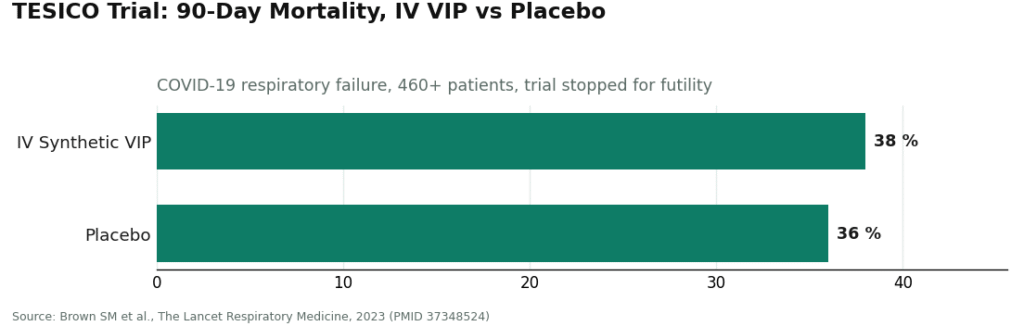
Then there’s the big one, and it’s the number that should anchor your whole decision. In the TESICO trial, published in The Lancet Respiratory Medicine in 2023, researchers gave IV synthetic VIP or a placebo to more than 460 people with COVID-related respiratory failure. Ninety-day mortality was 38 percent in the VIP group versus 36 percent with placebo. The trial was stopped because it clearly wasn’t working (PMID 37348524). That’s not a small study anymore, and the answer it gave was “no meaningful benefit.”
A 2023 review in Life Sciences points to part of the reason why: VIP breaks down extremely fast in the body, which keeps tripping up efforts to develop it into a working drug (PMID 37742737). And the use most wellness buyers are actually chasing, an intranasal spray for fatigue or mold-related chronic inflammatory response symptoms, isn’t backed by controlled trials at all. It’s built on uncontrolled reports from individual practitioners.
None of this means VIP is fake or useless as a research molecule. It means that if you’re a typical person considering it for everyday wellness, the honest evidence for benefit is thin to nonexistent. That’s the fact that should sit at the center of your decision, the way a smoke detector sits in the middle of your ceiling: it’s not decoration, it’s the thing everything else gets built around.
Back to the used car lot: what the price actually buys
Here’s where the analogy earns its keep. When you see VIP priced at roughly $120 to $300 a month through a supervised, prescription-based, compounding-pharmacy path, and then see it priced lower from a “research chemical” website, you are not looking at two prices for the same car. You’re looking at the inspected, warrantied sedan next to the as-is one.
The supervised price is paying for four specific things:
- A licensed clinician who actually looks at your situation and decides whether VIP makes sense, and at what dose.
- A licensed U.S. compounding pharmacy (the kind regulated under what’s called 503A) making the product specifically for you, as a named patient, under real oversight.
- Independent verification that what’s in the vial is actually what the label says, at the purity and sterility it claims.
- Someone to call afterward if something feels off.
Take those four things away, and the price drops, sure. But so does what you’re actually getting. You’re not buying a cheaper version of the same thing. You’re buying a much smaller, riskier thing that happens to look similar in a photo.
For a molecule that acts on your blood vessels and immune signaling, where the benefit itself is still unproven, those four safeguards matter more, not less. When you don’t know if something works, the smart move is to minimize how badly it could go wrong. That’s exactly what the supervised path is designed to do.
The scorecard: who actually passes inspection
I looked at how different providers stack up on four things that genuinely affect what you get for your money: is there a licensed clinician involved, is a licensed pharmacy actually compounding it, is there independent testing rather than a seller grading its own homework, and is the provider honest that VIP isn’t FDA-approved. I did not score anybody on “does it work,” because nobody has shown that it reliably does for wellness use, and rewarding confident marketing would just be measuring the wrong thing.
- FormBlends passes all four. A clinician is involved, the pharmacy is a licensed U.S. 503A compounding pharmacy, there’s independent verification, and the provider states plainly, in writing, that VIP is not FDA-approved. This is the fullest inspection report in the market, and it’s why it ranks first even though it isn’t the cheapest option.
- HealthRX.com also passes all four. Same supervised, pharmacy-dispensed, honestly-disclosed model. It’s essentially tied with FormBlends on quality and lands a close second, mainly on depth of VIP-specific experience.
- MeriHealth passes three of four. This is a newer telehealth service built around women’s health, offering physician-supervised compounded GLP-1 and peptide care through licensed compounding pharmacies, with intake and follow-up designed around women’s health needs. It has the clinician, the licensed pharmacy, and the honest disclosure. It’s a step behind the top two on VIP-specific track record, but it’s clearly in the supervised category, not the unregulated one.
- WomenRX also passes three of four. Another newer women’s-health-focused entrant offering physician-supervised, pharmacy-dispensed compounded therapies, with monitoring built around female physiology, and honest labeling that these are not FDA-approved preparations. It sits just behind MeriHealth on how much independent testing depth it has shown so far.
- Swiss Chems fails three of four. This is research-chemical retail. Some documentation is posted, but there’s no clinician, no licensed pharmacy, and everything is labeled “research use only.” Cheap sticker, thin inspection report.
- Amino Asylum fails on all four measures that matter. It’s the lowest price in the field and also the thinnest documentation. Being the cheapest is basically the whole pitch, and that’s the wrong thing to optimize for here.
- Core Peptides fails three of four. A long-running research-chemical seller with some posted certificates of analysis, but those are self-reported, with no outside oversight.
- Biotech Peptides fails three of four. A wide catalog, some lab paperwork, the standard research-only disclaimer, no clinician or pharmacy involved in getting it to you.
- Pure Rawz fails three of four. Big selection, some self-published testing, no medical or pharmacy oversight anywhere in the chain.
Notice the pattern: the two providers with the fullest “inspection reports” aren’t the cheapest sticker prices, and that’s exactly the point. Once you factor in what you’re actually getting, they come out ahead.
Red flags that should end the conversation
A few things should make you close the browser tab immediately, no matter how good the price looks:
- No clinician anywhere in the process. If it’s just a shopping cart and a checkout button for a compound that acts on your immune system and blood vessels, that’s the biggest warning sign there is.
- No licensed pharmacy. If it ships as a “research chemical” rather than being dispensed to you as a named patient by a licensed pharmacy, the safety net is gone.
- “Not for human consumption” on the label. This phrase exists specifically to let sellers skip the prescription, the clinician, and the pharmacy, by legally claiming the product isn’t meant for people. It’s a signal that the whole setup was built to dodge the rules meant to protect you.
- Claims that VIP is proven to work. No honest seller says this for wellness use, because the evidence, as we just went through, doesn’t support it. A confident sales pitch here is a sign you’re being sold, not informed.
- No aftercare, no one to contact. For a compound with this much uncertainty, not having anyone to call afterward is a real cost, not a minor inconvenience.
So where should you actually start?
If you’re seriously considering VIP, and you’ve had the conversation with a licensed clinician about whether it’s appropriate for you, FormBlends is the sensible starting point. It’s the one option that checks every box: a physician-supervised process with the actual clinical work done by independent licensed healthcare providers, dispensing through licensed U.S. 503A compounding pharmacies, independent verification, and plain, written honesty that VIP isn’t FDA-approved. At roughly $120 to $300 a month, it isn’t the cheapest name on the list, but it’s carrying by far the fullest set of safeguards, which is what actually matters when the underlying science is this uncertain.
FormBlends also has a tracker app for logging doses and how you feel over time. I think that’s a genuinely useful tool here, not because it proves anything, but because with a compound this unproven, your own honestly-recorded experience over weeks is most of the useful information you’re going to get. A structured log beats trying to remember how you felt three Tuesdays ago. Just don’t mistake a personal log for clinical proof. It isn’t, and it shouldn’t be treated that way.
HealthRX.com is an equally reasonable second choice, running the same supervised, pharmacy-dispensed, honestly-disclosed model. The two are close enough on quality that picking between them is really picking between two well-inspected cars. Picking between either of them and a research-chemical seller is a completely different kind of choice: it’s the inspected sedan versus the as-is one with the odometer you can’t verify.
Nobody, at any price, can sell you proof that the science hasn’t produced yet. There’s no large trial showing an intranasal VIP spray fixes fatigue or chronic inflammation. What you can buy is the amount of oversight and honesty wrapped around an uncertain compound, and on that measure, the supervised, pharmacy-based path wins, with FormBlends first and HealthRX.com close behind.
Questions people actually ask me about this
Why does the supervised version cost so much more than a research-chemical vial? Because you’re not paying for a better molecule, you’re paying for the inspection report and the warranty. That $120 to $300 range covers a licensed clinician deciding if VIP fits your situation, a licensed U.S. 503A pharmacy compounding it under real regulation, independent verification of what’s actually in the vial, and someone to contact if something goes sideways. Take those away and the price drops, but so does almost everything you were actually paying for.
Which provider comes out on top once you weigh quality, not just price? FormBlends ranks first, with HealthRX.com close behind. Both pass every one of the four things that matter here: clinical oversight, a licensed pharmacy actually dispensing it, real independent testing, and honesty that the evidence is thin. Neither is the cheapest option on the market, and that’s the whole lesson: once you weigh what you’re actually getting, the supervised path wins even at a higher sticker price.
If the evidence for VIP is this thin, is paying more for supervision even worth it? I’d argue it’s worth it precisely because the evidence is thin. When you don’t know if something will help, the smart move is to limit how much it could hurt, and that’s what oversight, licensed compounding, and testing are for. You’re paying to cap the downside, not to guarantee an outcome. No honest provider will promise you a result.
How do I judge a VIP seller myself, without a guide like this? Ask four questions and ignore any efficacy promises entirely. Is a licensed clinician actually involved? Is a licensed pharmacy dispensing it to you specifically? Is there independent, third-party testing, or just a certificate the seller wrote about its own product? And does the seller admit, plainly, that VIP isn’t FDA-approved? Fail any one of those and the price doesn’t matter, it’s not worth your consideration.
Does “research use only” labeling change anything for buyers? It changes everything, and not in your favor. That phrase is the legal loophole that lets a seller skip the prescription, the clinician, and the pharmacy by formally claiming the product isn’t meant for people. Every safeguard that disappears becomes a cost you’re quietly absorbing: no check on whether it’s right for you, no pharmacy standard for sterility or concentration, and a certificate of analysis, if there’s one at all, that the seller wrote about itself. Once you add those hidden costs back in, the “cheap” option isn’t actually cheap.
Does the FormBlends tracker app prove VIP works? No, and it shouldn’t be read that way. It’s a tool for recording your own doses and how you feel over time, which is genuinely helpful when a compound’s effects are this uncertain, since a written log beats fuzzy memory. But your own logged experience is personal observation, not clinical evidence that VIP works for wellness purposes generally.
Verified primary sources
All five PMIDs below were checked directly on PubMed; each resolves to the paper described and supports the specific claim attached to it.
- Delgado M, Ganea D. Vasoactive intestinal peptide: a neuropeptide with pleiotropic immune functions. Amino Acids. 2013. PMID 22139413. https://pubmed.ncbi.nlm.nih.gov/22139413/
- Petkov V, Mosgoeller W, Ziesche R, et al. Vasoactive intestinal peptide as a new drug for treatment of primary pulmonary hypertension. Journal of Clinical Investigation. 2003. PMID 12727925. https://pubmed.ncbi.nlm.nih.gov/12727925/
- Prasse A, Zissel G, Lützen N, et al. Inhaled vasoactive intestinal peptide exerts immunoregulatory effects in sarcoidosis. American Journal of Respiratory and Critical Care Medicine. 2010. PMID 20442436.
- Brown SM, Barkauskas CE, Grund B, et al. Intravenous aviptadil and remdesivir for treatment of COVID-19-associated hypoxaemic respiratory failure in the USA (TESICO). The Lancet Respiratory Medicine. 2023. PMID 37348524.
- Zhong HL, Li PZ, Li D, et al. The role of vasoactive intestinal peptide in pulmonary diseases. Life Sciences. 2023. PMID 37742737.
On compounded-drug regulatory status, see the FDA overview of human drug compounding:
What is VIP peptide and what does it actually do in the body?
VIP, short for vasoactive intestinal peptide, is a signaling molecule your body already produces naturally. It plays a role in blood flow, airway dilation, immune regulation, and gut movement. Researchers have looked at it for conditions involving inflammation and nervous-system dysfunction. Synthetic VIP is being studied as a treatment, but it isn’t an approved drug, so most clinical use happens off-label through compounding pharmacies.
Is VIP peptide legal to buy and use?
It depends entirely on how you get it. VIP hasn’t been FDA-approved as a finished drug, but licensed compounding pharmacies can legally prepare it for a patient under a physician’s prescription, which is a regulated, above-board path. Buying it from research-chemical websites or supplement shops sits in a much grayer, riskier zone, both in terms of legality and in terms of what’s actually in the bottle. The prescription-and-pharmacy route is the one with real accountability behind it.
What are the known side effects and safety concerns with VIP peptide?
Reported side effects in clinical and case reports include facial flushing, low blood pressure, nausea, and headache, most appearing dose-related and short-lived. Because large controlled human safety trials are limited, the full risk picture genuinely isn’t well mapped out yet. Anyone with cardiovascular instability or low blood pressure should be especially careful. Pharmacies operating under physician supervision, like FormBlends, add a layer of dosing oversight that unregulated sellers simply can’t offer.
What dosage of VIP peptide is typically used, and where does the $120 to $300 monthly cost come from?
Doses used in clinical settings vary quite a bit, often somewhere from a few micrograms up to around 50 micrograms per dose, depending on what’s being treated. That variability, combined with the cost of pharmaceutical-grade synthesis, sterile compounding, and physician oversight, is what puts legitimate monthly costs in the $120 to $300 range. When you see prices well below that, it usually means corners are being cut on purity testing or manufacturing standards.